Showing posts with label Lipton. Show all posts

Tuesday, January 31, 2017

Tea Review Tuesday - A Review of Lipton's English Breakfast

In the past, I have discovered that - outside of the United States - Lipton offers a number of teas that are of a much higher quality than their run-of-the-mill, dust-like attempt at black tea, which they sell all over the United States. (If it sounds like I have a bias, it is because I certainly do...for as inexpensive as tea can be, I find it unfortunate and a disservice to tea drinkers to offer such a low-quality brew.) The "higher quality" is of course relative to what is being mostly offered here in the United States, and it is possible that the tea I will be reviewing today has been imported and is available here. However, in hunting grocery stores, I have not been able to find it. A quick search of Amazon reveals something called "Daring English Breakfast," which can be ordered here State-side, but I am not sure if it is a separate offering from today's review or simply a re-branding.

Today's review covers Lipton's English Breakfast, advertised as "Exclusive Selection" on the package. From their marketing website, this seems to suggest a line aimed at businesses with "quality you can see." This marketing toward businesses fits with the fact that I picked up this teabag at a hotel in the Netherlands recently.

Opening the teabag, I feel as though I cannot see much of anything. The pyramid bag is fairly translucent. However, the tea in the bag feels as though it has been ground pretty fine. It also has the same smell of generic Ceylon as the Lipton Black Tea one finds here in the United States.


Following the steeping instructions (which had very communicative pictures), I poured a cup of just-boiled water over the tea and left it for two minutes so as not to risk over-steeping. Once the steeped cup had cooled, I prepared for tasting. The aroma of the tea smells to me like a typical English Breakfast, albeit a bit flat and unremarkable.


My first sip almost surprised me. For a moment, the tea seemed like a nice, smooth, flavorful cup, while it was on the tip of my tongue. Then, it washed over the rest of my mouth, and the astringency came through. At least the tea is drinkable. It could probably be doctored with milk and sugar and be less harsh. I also feel as though my two-minute steep time was such that the tea should not have gotten oversteeped, which leads to me to believe that the quality of the leaves led to it being this bitter. The flavors almost have a bit of complexity to them, though not a lot. There is a touch of malty flavor that hints at an Assam, or it could be that they are using a rather robust Ceylon. (South Asian teas are an area in which I wish I knew more!)


If this tea were available to the public, I would say that it would make a great alternative to the Lipton Black Tea that is sold in grocery stores. It could be used for making very inexpensive iced tea and would likely produce better results than other, cheap black teas. However, I think that in all tea brewing, there is no substitute for decent - if not good - quality leaves. On my personal enjoyment scale, I would rate this tea a 2.


Photo credit to Built from Ink and Tea.
You can learn more about this tea from their marketing website, here. Some hotels and businesses source it for their tea offering.
This review was unsolicited and uncompensated.
You can read more about my Personal Enjoyment Scale, here.
Text is copyright 2017, Built from Ink and Tea.

Tuesday, July 16, 2013

Tea Review Tuesday - A Review of Lipton's Kericho Estate Tea

A couple of months ago, I reviewed one of Lipton's "premium" offerings, their Darjeeling, of which the only premium aspect seemed to be the label design. As I had picked up a bag of this Kenyan black tea at the same time as the Darjeeling, I made it a goal to review them both, eventually, even just for the sake of warning you all away from them (or perhaps finding a hidden gem). Previously, I had said that I would review this tea a week after the Darjeeling, but I simply could not bring myself to do so.

Compared to the Lipton Darjeeling, this one...tastes like Lipton Yellow Label with strong coffee or earthy tones. I love pu'erh, so I am no stranger to earthy tones, but these just make it taste "deep," rather than giving it any sort of complexity. When it is first sipped, there is barely any taste at all. As the tea passes over the back of the tongue, rough bitterness follows, leaving the mouth feeling like it is coated with a slightly chalky feeling. Quite frankly, this tea is not worth the money being charged for it, nor is it worth time to describe further its poor qualities.

To find one redeeming quality, I would say that I would gladly drink this tea over the Lipton Darjeeling, if those were my only two options. However, it should be pointed out that the Lipton Darjeeling is one of the worst teas I have ever consumed. On my personal enjoyment scale, I rate this tea a 20/100.


This tea is available from various online retailers.
Photo credit to ebay.de.
This review was unsolicited and uncompensated.

Tuesday, May 14, 2013

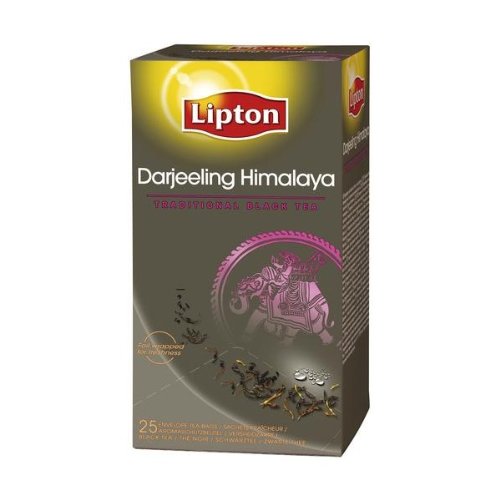
Tea Review Tuesday - A Review of Lipton's Darjeeling

In some respects, I find it hard to believe that I am actually reviewing a tea that is sold by Lipton. Quite some time ago, when I was first starting to "get into" tea, I discovered quickly that Lipton bagged teas were far from quality, when compared with some other bagged tea offerings, as well as nearly every loose leaf tea. The contents of each tea bag tasted as though they were fannings, which are the leftover dust of broken tea leaves. Yet Lipton's bagged teas were so inexpensive that they became the go-to bagged tea for hotels, restaurants, convenience stores, etc. looking to offer a tea that was cheap.

In more recent years, with the rise in tea's popularity among the masses, Lipton has been striving to bolster the quality of their offerings, at least from the visible aspect. Switching to pyramid infusers for some of their "premium" lines, offering flavored black teas, actually delving into the areas of white tea and rooibos (albeit flavored on both counts), and expanding upon their herbal blends are all examples of their attempts. (The current obsession with flavoring teas is another story/blog post entirely...) Another try on their part is branching beyond the "black tea" label to special, regionalized offerings. Today's review will touch on their Darjeeling.

Traditionally, Darjeeling tea is sourced from a specific region in India, but the packaging for this tea bag has no source information. Because it is one of their "premium" teas, the label is at least a bit fancier than their generic black tea or even their Yellow Label tea. As three to five minutes of steep time in just-boiled water are recommended, I choose the low end (having already tried a cup of this, yesterday, that was steeped for four minutes and tasted entirely over-infused).

My thoughts from yesterday's cup had been along the lines of "I had been struck by a small ray of hope upon seeing that Lipton had been branching into what appeared to be slightly fancier teas. Unfortunately, after a very short steep, the produced cup was both bitter/astringent and not particularly flavorful." Having reduced the steep time for today's cup, I hoped that I could at least discern some better flavors with perhaps a touch more complexity.

No. No, no, and some more no. I wonder why this tea tastes like their generic black tea with a touch of darjeeling flavors? On one hand, I can at least tell that it is supposed to be darjeeling, so that very, very slightly satisfies my hope. On the other, massive hand...it tastes terrible. In fact, only the aftertaste is really darjeeling. The smell and initial flavors are rough and more reminiscent of an assam of low quality (sans the typical maltiness of an assam). Thankfully, this was a teabag that I picked up from the office and not something on which I spent money. The one redeeming factor about this tea is that worse teas do exist...but that is not saying much. On my personal enjoyment scale, I would rate this tea an 18/100.

Next week, I will review another one of these "premium" offerings from Lipton - the Kericho Estate Tea from Kenya.

Lipton's Darjeeling can be purchased from Amazon and a number of supermarkets. (However, I highly recommend Peet's Darjeeling as a readily available and far superior alternative.)
Photo credit to Amazon.
This review was unsolicited and uncompensated.